News
Reflections from the LandScale regenerative agriculture launch event
What does it take to make regenerative agriculture work at scale? Drawing on insights from LandScale’s Regenerative Agriculture Assessment Lens launch, this story explores why a landscape perspective matters, and how shared data, governance, and collaboration can turn ambition into lasting change.

Turning regenerative ambition into landscape-level action
On November 18, just ahead of the Sustainable Agriculture Summit in Anaheim, California, LandScale convened an exceptional group of practitioners, corporate leaders, nonprofits, and landscape experts. The occasion? The official launch of our new Regenerative Agriculture Assessment Lens.
The timing couldn’t have been more critical. Across the food and agriculture sectors, a consensus is emerging: the resilience of ecosystems, communities, and supply chains is not a separate conversation; they are deeply intertwined.
Sustainability has shifted from a “nice to have” corporate initiative to a non-negotiable operational requirement. We now understand that healthy landscapes do more than just improve environmental outcomes. They underpin reliable sourcing, support rural livelihoods, and make regenerative agriculture possible at scale. However, achieving this requires more than isolated efforts on individual farms. It demands collaboration, a shared vision, and a willingness to rethink how we manage systems that stretch far beyond any single fence line.
This event provided an opportunity to step back, learn from one another, and envision the future of sustainable agriculture.
Why start with landscapes?
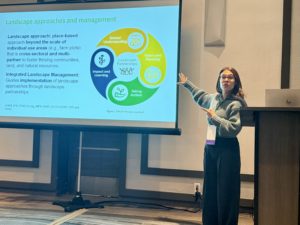
The session began with framing remarks from Bemmy Granados, who reminded the room why landscape approaches matter so much in our current climate.
Farm-level practices are essential, but even the strongest individual efforts cannot fully address systemic issues like water scarcity, biodiversity loss, labour rights, or economic vulnerability. These challenges do not respect the boundaries on a map. Landscapes, by definition, connect everything: ecological processes, governance structures, market forces, and community well-being.
This is why regenerative agriculture needs a landscape lens. Without it, we miss the bigger picture, risking the effectiveness of our interventions and the longevity of our supply chains.
Introducing the Regenerative Agriculture Assessment Lens
After grounding the room in a shared understanding of landscape approaches, Alice Gottesman and Conrado Guzman introduced the newly launched Assessment Lens. They walked participants through the development process, explaining how this tool addresses specific gaps in current regenerative agriculture frameworks.
The Assessment Lens helps stakeholders:
- Understand Conditions: Gain a holistic view of the social and environmental context.
- Track Progress: Measure changes over time against a standardized baseline.
- Align Investments: Ensure funding and resources are directed toward high-impact areas at a landscape scale.
In short, the Lens translates ambitious regenerative goals into something measurable, practical, and aligned across various actors. It supports both production-level improvements and broader, long-term landscape resilience.
A conversation across perspectives: Insights from the panel
One of the most energizing components of the event was the panel discussion. The lineup, featuring landscape leaders, corporate representatives, nonprofit practitioners, certification experts, and regenerative agriculture specialists, facilitated a powerful, multidimensional conversation.

Here are five key reflections that resonated with the room:
1. Governance is hard and necessary
Corporate representatives acknowledged a difficult reality: shifting governance models and genuinely sharing power is challenging. Nida Bockert from Nestlé Zone Americas spoke candidly about the discomfort organizations often feel when ceding control, particularly when landscape coordination can require significant overhead, sometimes up to 30%.
However, as the panellists emphasized, these costs should not be viewed as expenses. Rather, they are vital investments in long-term, community-led outcomes that secure the future of the supply shed.
2. Community leadership must be at the centre
Participants repeatedly returned to the importance of elevating local voices. Building trust, establishing governance, and creating space for local priorities all take time. Yet, without these elements, landscape efforts simply cannot succeed.
A significant barrier identified was that many communities do not realize they can, and should, lead these efforts. The confusing patchwork of industry terminology, such as “landscape approaches,” “jurisdictional approaches,” or “integrated landscapes,” often makes engagement feel overwhelming. Simplifying this language and empowering local leadership is a critical next step.
3. Value chains and landscapes need better alignment
The panel explored the inherent tension between global value chains and local landscapes. Value chains are often fast-moving and narrowly focused on farm-level metrics. In contrast, landscapes are local, slow to change, and shaped by complex social and ecological dynamics.
While plot-level tools are incredibly useful, they struggle to capture broader outcomes such as watershed health, biodiversity trends, carbon dynamics, and social resilience. These factors are critical for maintaining resilient supply sheds, especially as climate impacts intensify.
4. Practical challenges are real
Data gaps, the high cost of assessment, and long timelines continue to slow progress. Gabriella Scolio from The Nature Conservancy shared how LandScale has helped overcome “participation fatigue” by offering clarity and structure during moments when stakeholders feel overwhelmed. Having a clear framework helps maintain momentum even when practical challenges arise.
5. Regenerative agriculture is a powerful entry point
Perhaps the most encouraging takeaway was the role of regenerative agriculture as a catalyst. When rooted in local context, it opens the door to full landscape conversations. It gives stakeholders a common starting place, a tangible vision, and a pathway toward deeper transformation.
The big picture: What we’re learning
Throughout the launch, several themes rose above the rest, offering a roadmap for the future of the industry:
- Landscapes are essential to scaling regenerative outcomes. We cannot fix the whole by only focusing on the parts.
- Communities must steer the process. Local stakeholders cannot sit on the sidelines; they must be the captains of their own landscapes.
- Collaboration is key. No single actor, whether corporate or government, can drive transformation alone.
- Coordination is an investment. Governance structures are not inefficiencies; they are the bedrock of success.
- Landscape-level measurement brings visibility. We need to see the outcomes that farms alone cannot capture.
- Persistent barriers need attention. Issues like data gaps and funding shortages require sustained, collective effort to resolve.
Looking ahead
The launch of the Regenerative Agriculture Assessment Lens is a significant milestone, but more importantly, it is an invitation.
It is an invitation to think bigger than individual fields. It is a call to collaborate more deeply across sectors and to build landscapes that are resilient, ecologically, socially, and economically. Most of all, it is an opportunity to recognize that regenerative agriculture and thriving landscapes go hand in hand.
We look forward to seeing how organizations and communities use this new Assessment Lens to drive meaningful change.