Guiding principles for robust landscape assessment
Seven principles. A shared foundation for credible landscape assessment.

A principled approach to landscape assessment
Bringing evidence, context and local perspectives together
Landscape sustainability is complex. Understanding it requires more than data alone, it requires approaches that consider what matters to people, the local context, and how landscapes change over time. Our Guiding Principles help guide landscape assessments by prompting us to consider the bigger picture, draw on credible evidence, include local perspectives, and recognize different values and interests. Rather than operating independently, the principles complement one another and can inform different stages of a landscape assessment, from defining the landscape and selecting appropriate methods to interpreting findings and supporting continuous learning.
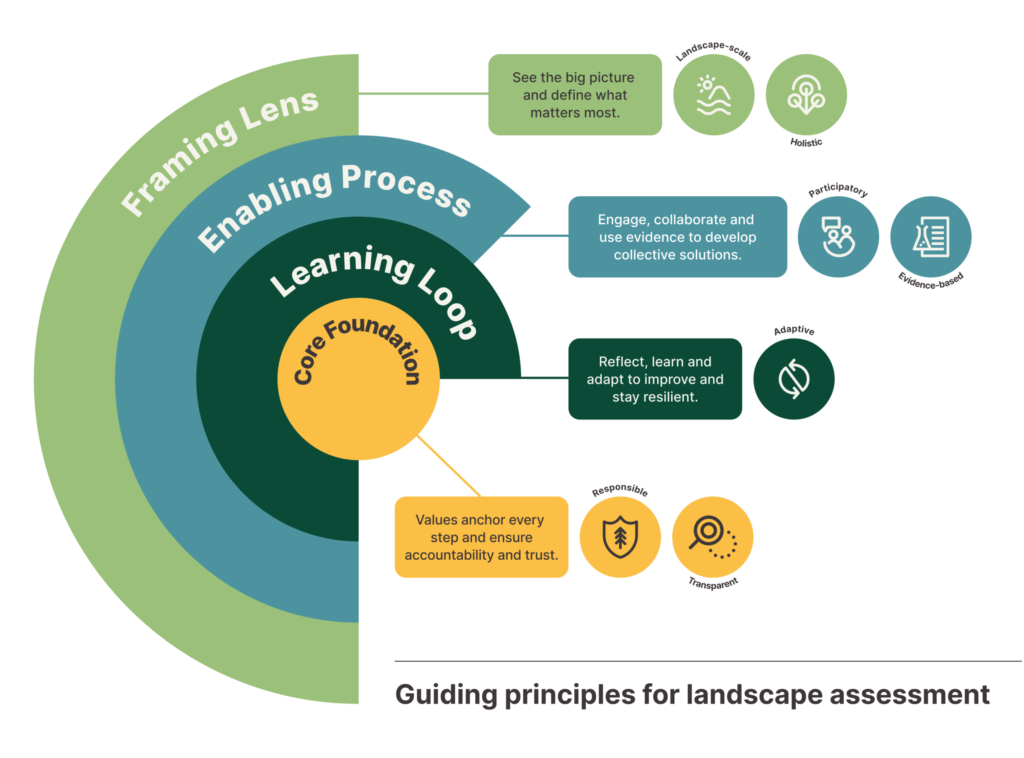
Our Guiding Principles

Responsible
Ethical conduct, respectful engagement, and responsible data use are fundamental to credible landscape assessments.

Landscape-scale
Landscape-scale assessments look across the whole landscape rather than focusing on isolated sites, projects, or activities, enabling a broader understanding of landscape-level conditions and change.

Holistic
Understanding landscape sustainability requires a systems-based perspective that considers ecosystems, human well-being, governance, and production together.

Participatory
Meaningful engagement of diverse stakeholders helps ensure assessments reflect local realities, incorporate multiple perspectives, and foster shared responsibility.

Evidence-based
Credible landscape assessments draw on robust data, scientific evidence, and reliable knowledge, supported by transparent and well-documented methodologies.

Transparent
Open communication of methods, assumptions, and findings strengthens accountability, builds trust, and supports shared learning.

Adaptive
Assessment approaches should evolve over time, incorporating new knowledge, changing conditions, and lessons learned to remain relevant and useful.
Putting the principles into practice
These Guiding Principles are more than statements of intent—they provide guidance on how landscape assessments are designed, implemented, and communicated. They are intended to support landscape assessment broadly, with LandScale providing one example of how they can be applied in practice. For example, they inform the ongoing development of LandScale’s monitoring and assessment system, helping us strengthen our approach as knowledge, technology, and landscapes evolve. The Guiding Principles are not prescriptive requirements or a fixed methodology. Rather, they provide a basis for making informed decisions, asking the right questions, and learning and improving over time.
Assessment framework
The principles inform the ongoing development of indicators, metrics, and methodologies, supporting landscape-scale relevance and holistic understanding.
Assessment process
The principles help shape assessment approaches by encouraging participation, evidence-based practice, and adaptation to different landscape contexts.
Validation
The principles inform quality assurance by reinforcing the importance of participation, data integrity, transparency, and credibility.
Online platform
The principles guide the continued development of how landscape data are managed, presented, and shared to support transparency and informed decision-making.
Communications
The principles help ensure communications are evidence-based, transparent, responsible, and grounded in the realities of each landscape context.
Learn more about LandScale
Discover how LandScale supports credible landscape sustainability assessment through its assessment framework, methodology, validation process, and online platform.